 Home
Home
Uncategorized
Balancing Modern Education with Indian Values: A Personal Reflection
Published On: January 27, 2026
As someone who has been in the education and its systems for very long time, there is often one question which keeps popping in my mind. With the technology filled world, marks oriented attitude, skills promotion for job and excelling in everything, there is a much deeper question that keeps coming back to me—are we helping our children become good human beings?
Whenever I meet parents in PTM, there are various concerns and talk shared between parent and me. There are talks about marks, grades, skills, lesson plans, upcoming session and many more. Parents want their children to do well, to be independent, to face the world with strength and self-belief. But there is a fear which lies under- whether my child will forget his/her roots, will my child forget respect for elders, patience, kindness, or the sense of right and a global future.
In today’s world, parents are not against modern education or they are not old fashioned. They are just concerned about their kids not forgetting basic things which they have inherited from their parents.
In schools, we prepare children for their future and the outside world. But we want them to be kind and empathetic too. Education should shape sharp minds, yes—but also compassionate hearts. When learning is balanced with values like empathy, discipline, respect, and humility, children don’t just succeed in exams; they grow into individuals we can truly be proud of.
There is no doubt that education today has changed so much and is completely different from earlier times. Children have access to information that one can not even imagine. They are confident and speak without hesitation. They question, they reason, and they are not afraid to express themselves. These are their growing signs, and as a teacher, I appreciate it a lot.
However, I can also see the pressure they are under. the need to perform all the time. the dread of not succeeding. Screens are a distraction. Many kids find it difficult to focus, slow down, and sit quietly while thinking. Patience is hard to come by. Emotional equilibrium is brittle.
Sometimes I feel that education has become too rushed. We want results quickly. We want achievement early. And in this hurry, we risk forgetting that children are still growing—emotionally, mentally, morally.
This is where I feel education must pause and ask itself: What are we really nurturing?
When I was in school, classrooms are not just for learning from books, but its about learning how to survive, how to be a good human being. Respect for elders, honesty, humility, self-control—these were not taught formally. They were simply part of daily living.
Indian culture has always seen education as something sacred. The older system not only focus on teaching lessons, it’s about shaping the individual.
Today, some people feel that these values belong to the past. I strongly disagree. In fact, the more competitive and confusing the world becomes, the more relevant these values are.
I have seen that children who are rooted in values handle success better and failure more calmly. They may stumble, but they don’t lose themselves. They have a sense of direction that doesn’t come from marks alone.
At Swaminarayan Gurukul, I have seen a sincere effort to strike this balance. Here, education is not treated as a race. It is treated as a journey.
The belief is simple yet powerful with strong message: Before creating successful professionals, we must help our children become good human beings.
Academic excellence is encouraged, and rightly so. Children are motivated to ask questions, to explore, to aim high. But the motive of education should be clear to them, they should know why they are learning and what they are learning.It should be made clear to them that education is not just individual growth, but also for society’s improvement.
Morning prayers, yoga, and meditation play an important role here. I have noticed how these quiet moments help children begin the day with calmness. These are not forced rituals. They are gentle tools that teach children how to pause, reflect, and centre themselves.
And when children learn how to slow down internally, they learn better externally too.
The word “Discipline” come with a lot of strictness and heaviness. It brins the image of strict rules, raised voices, or fear. But in my opinion, discipline is not a cage but it gives you a freedom, a freedom to live your life the way you want.
“Think about it: as adults, we feel anxious when we don’t know what’s expected of us at work or in a new city. Kids feel that tenfold. When we give them clear boundaries and steady routines, we aren’t ‘boxing them in’—we’re actually giving them a soft place to land.
When the ‘rules of the road’ are fair and consistent, a child doesn’t have to spend their day looking over their shoulder or worrying about making a mistake. They can finally stop wondering ‘Am I okay?’ and start wondering ‘What can I learn today?’ That sense of security is what gives them the courage to actually go out and explore the world.”
At Gurukul, we try to move away from the idea of punishment. Instead, we focus on responsibility and mutual respect. It’s a slower process, but it’s a more permanent one.
The most rewarding part of my job is watching that shift happen. You see a child start doing the right thing not because an adult is watching, but because it feels right to them. They carry that quiet strength with them long after they leave our halls. To me, that isn’t just “good behavior”—that is the ultimate success of an education.
The most common misinterpretation most of us ha is that value based education system rejects the idea of modern education. But its not the case.
At Swaminarayan Gurukul, modern teaching methods, technology, and updated curricula are actively embraced. Smart classrooms, language skills, scientific curiosity, sports, arts, and leadership opportunities—all of these matter in a child’s growth. Everyone has access to all but what makes them different is how they choose to utilise thee resource or their own use.
Children should understand that technology, mobile phones are their helping hand, not just a distraction. They hould understand that success got by shortcuts has no value but the success which comes with honesty, hardwork carries a lot of value.
From what I’ve seen and experienced, values can not be learnt through moral preaching or life skills books. These values don’t come from big speeches or lessons alone. They grow quietly in small, everyday moments— in the way we speak to one another, how we handle difficult situations, and how we show respect in our daily actions. It is in these simple, everyday, ordinary moments where children actually understands and learn thee small yet important lessons.
Teachers play a crucial role here—not just as instructors, but as role models. Children observe everything. How we speak. How we react. How we handle pressure.
Stories from Indian scriptures, the lives of great leaders, and the teachings of Bhagwan Swaminarayan are shared in a way that feels relevant and relatable. These stories are not meant to preach. They are meant to make children think.
And when children reflect, real learning happens.
As a teacher, one of my biggest worries is that while children are often trained well for exams, they’re not always prepared for life itself. Life doesn’t follow a syllabus—it brings failure, disappointment, confusion, and difficult choices. And no textbook alone can prepare them for that.
This is where value-based education makes all the difference. It gives children an inner strength that marks can never measure. It teaches resilience when things go wrong, humility when success arrives, and compassion in relationships. Over the years, I’ve noticed that children who truly know themselves—who understand what they stand for—are far less likely to be swayed by negative influences. They think before they act, they take responsibility, and they make choices with clarity.
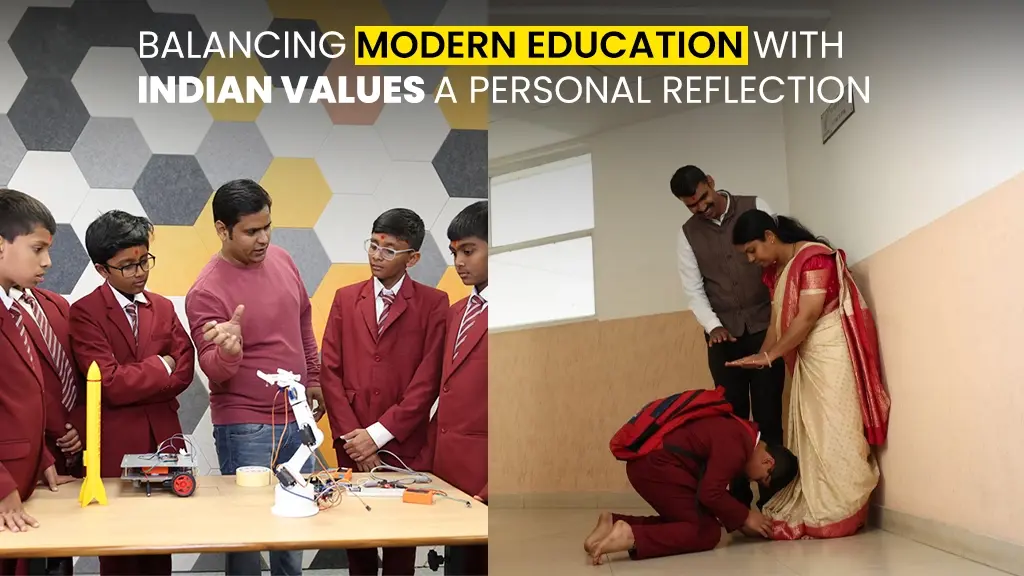
For me, balancing modern education with Indian values is not about choosing one over the other. It’s about weaving them together. It’s about letting children dream big while staying grounded. About aiming high while remaining humble. About achieving success without losing empathy.
At Swaminarayan Gurukul, I see this balance in action every day. Knowledge grows hand in hand with character. Achievement is guided by values. And that combination is powerful.
The world around us is changing faster than ever, but values remain timeless. Education that nurtures both the mind and the heart creates individuals who don’t just succeed—they contribute meaningfully to society.
From my own experience, true education is not measured by how much a child knows. It is measured by who the child becomes. And that, I believe, is the kind of education that truly lasts.